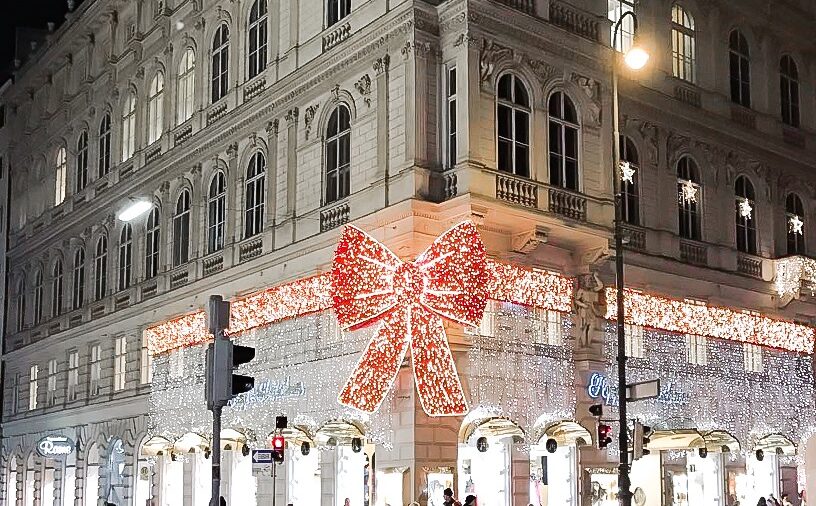
The Red Christmas Bow
Vienna, collective memory and the changing face of Christmas traditions.
There are certain things that quietly become part of a city’s identity. Not necessarily monuments or grand architectural landmarks, but familiar details that return year after year, becoming part of the way we remember a place.
In Vienna, one of them has been a giant red bow. For seventeen years, the illuminated Christmas bow on the façade of Palais Todesco, at the corner of Kärntner Straße and Walfischgasse, has marked the beginning of the festive season for generations of Viennese and visitors alike.
Suspended above the entrance of Popp & Kretschmer, opposite the Vienna State Opera, it became much more than a Christmas decoration. A meeting point, a familiar photograph, a small seasonal ritual. Eventually, one of Vienna’s most recognisable Christmas images.
A little history behind the setting
The setting itself could hardly be more Viennese. Palais Todesco was built between 1861 and 1864 for the banker Eduard von Todesco and his brother Moriz. Designed by Ludwig Förster and Theophil Hansen, the palace is one of the remarkable examples of Vienna’s nineteenth-century historicist architecture.
Its elaborate interiors and grand reception rooms once hosted the social and cultural life of the city. Today, the building remains a familiar presence in the historic centre, where architectural heritage and contemporary urban life meet.
And somewhere along the way, a bright red bow became part of its story.
When a tradition becomes collective memory
First installed in 2009, the oversized bow gradually found its place in Vienna’s Christmas landscape.
Over the years, people photographed it, arranged to meet beneath it or simply recognised it as a sign that Christmas was approaching. Social media gave it a new dimension, turning a local seasonal tradition into an internationally recognisable image of Vienna during Advent.
But perhaps its real significance lies elsewhere.
Cities are not remembered only through their famous buildings, museums or historic squares. They are also shaped by small, recurring rituals: the first Christmas lights, a familiar shop window, the same street corner photographed every December.
These details create a sense of continuity and belonging. They become part of a collective memory, often without us even realising it.
The year the bow disappeared
In 2026, the familiar image changed. Following new safety requirements imposed by the City of Vienna, Popp & Kretschmer decided not to install the bow on its exterior façade this year.
The requirements included a privately funded security service to manage visitor crowds, as well as the possibility of dimming or switching off the illumination when necessary. The company ultimately considered these conditions unfeasible.
The bow, however, has not disappeared entirely. It now sits behind the shop windows, where visitors can still see it and share the social motto #freethebow.
The decision sparked considerable discussion, revealing just how attached people had become to an object that, at first glance, was simply festive decoration.
Suddenly, a Christmas bow became a conversation about public space, safety, tradition and the character of a city.
A new Christmas landmark: Hotel Sacher
And just a few steps away, another Christmas image has appeared.
To celebrate its 150th anniversary in 2026, Hotel Sacher Vienna has unveiled a spectacular seven-metre illuminated Christmas tree installation on its façade. Officially switched on in early November, it has already become a new festive attraction in the heart of the city.
There is something particularly interesting about the timing.
While the familiar red bow has moved behind the shop window, the neighboring Hotel Sacher has introduced a new seasonal landmark, adding another chapter to this corner of Vienna’s Christmas story.
Both installations transform architecture into an experience, inviting people to stop, look and take a photograph. Yet they also raise a broader question about how cities evolve, how traditions are replaced or reinvented, and what makes a particular image become part of a city’s identity.
Perhaps Vienna doesn’t necessarily lose its Christmas icons. Sometimes, it simply makes room for new ones.
What makes a city feel like home?
I find it fascinating how certain visual details become emotionally significant over time. We might walk past them hundreds of times without giving them much thought, until one day they are no longer there.
Perhaps that is when we understand their value. The red bow at Palais Todesco is a reminder that a city’s identity is not made exclusively of grand architecture or historical heritage. It is also built through everyday experiences, familiar images and shared memories.
Whether it returns to its place above Kärntner Straße in the coming years remains to be seen.
For now, Vienna has a new Christmas landmark, but one familiar scene is still missing.
And perhaps that is why so many people miss it.

